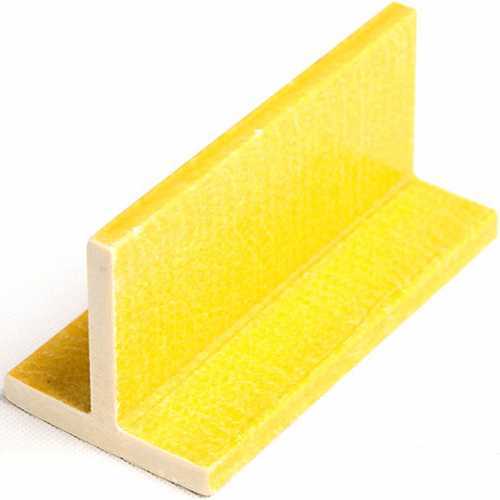
Fiberglass T Shape Profile

Fiberglass T profiles, also known as FRP T profiles or fiberglass T sections, are pultruded structural profiles with a vertical web and horizontal flange. Made from glass fiber reinforcement and a thermosetting resin matrix, they are used where corrosion resistance, dimensional stability, and electrical non-conductivity are required. Common uses include structural framing, stiffeners, supports, and bracing. Profile dimensions, resin system, and reinforcement configuration influence the mechanical performance of the selected section.
A fiberglass T profile is a composite structural section with a T-shaped cross-section, manufactured by pultrusion. The profile combines continuous glass fiber reinforcement with a thermosetting resin matrix to form a consistent structural section. Fiberglass T profiles are considered for applications where a non-metallic profile is needed for framing, stiffening, support, or bracing. Unlike steel, FRP does not rust, and its non-conductive nature can be useful in electrically sensitive environments.
The profile is produced by pultrusion, a continuous manufacturing process in which glass fiber reinforcement is combined with resin and pulled through a heated forming die to create the T-shaped section. The process aligns a substantial portion of the reinforcement along the profile length and forms a repeatable cross-sectional geometry.
Resin selection can be matched to the intended service environment. Polyester is commonly used for general-purpose applications, while vinyl ester and epoxy systems can be selected when different chemical, environmental, or mechanical requirements apply. Surface finish and color can be specified according to the selected product configuration.
Fiberglass T profiles are used in industrial and infrastructure applications where a lightweight, non-conductive, corrosion-resistant structural profile is required. Typical application areas include chemical processing facilities, wastewater treatment, marine and coastal environments, electrical installations, equipment support frames, and secondary structural framing.
Depending on the section size and project design, T profiles can be used as stiffeners, framing members, supports, edge members, or bracing elements in permanent and modular assemblies.
Several design and service factors are normally considered when selecting a fiberglass T profile:
Mechanical behavior varies with profile dimensions, reinforcement configuration, resin system, span, support conditions, loading, and service environment. For project-specific selection, provide the required profile dimensions together with the intended span, support arrangement, load conditions, and environmental requirements.
This information helps determine which T-profile configuration is appropriate for the intended application and which product data should be considered during engineering review.
| Property | Options / Description |
|---|---|
| Material | Fiberglass Reinforced Polymer (FRP / GRP) |
| Manufacturing method | Pultrusion |
| Profile geometry | T-section |
| Standard lengths | 3 m, 6 m, or project-specific cuts |
| Resin systems | Polyester, vinyl ester, epoxy |
| Surface | Smooth or project-specific finish according to configuration |
| Color | Standard industrial colors or project-specific options |
| Electrical property | Non-conductive |
They can be considered for sustained-load applications when the profile is selected for the required geometry, span, support conditions, loading, temperature, and resin system. Structural selection should be based on the actual project configuration.
Yes. FRP T profiles are used in many wet, coastal, wastewater, and corrosive industrial environments. The appropriate resin system should be selected according to the specific chemicals, temperature, exposure conditions, and service requirements.
Standard 3 m and 6 m lengths can be supplied, and project-specific cuts can be considered where required. Other configuration options depend on the selected profile and project requirements.
Fiberglass T profiles are non-metallic, non-conductive, and not subject to steel rusting. Their weight, stiffness, strength, connection behavior, and thermal characteristics differ from metal sections, so the appropriate material and profile size should be selected for the actual design requirements.
Fiberglass T profiles are often used with other FRP structural sections and connection products. Related products include:
For compatible product selection, see our FRP Profiles overview or review related structural profile products.
For a project-specific fiberglass T profile selection, provide the following information:


