

Fiberglass Cable Trench Cover Overview
Fiberglass cable trench covers, also referred to as FRP cable trench covers, GRP trench lids, or fiberglass trench lids, are composite cover panels used to close and protect cable trenches, utility channels, pits, and similar access areas. They are made with glass fiber reinforcement in a thermosetting resin matrix and can be supplied with smooth or anti-slip surfaces. Dimensions, reinforcement, and load requirements depend on the project configuration and support conditions.
What Is a Fiberglass Cable Trench Cover?
A fiberglass cable trench cover is an FRP/GRP composite panel used over cable trenches, utility channels, pits, and related access areas. The cover separates and protects the space below from routine environmental exposure and surface access conditions while providing a non-metallic cover solution for cable and utility infrastructure.
Depending on the selected configuration, the cover may be supplied with different dimensions, reinforcement arrangements, resin systems, and surface textures. Common product terms include fiberglass trench cover, FRP trench cover, GRP trench lid, fiberglass trench lid, and non-metallic utility cover.
Key Product Facts
- Material: Glass fiber reinforcement embedded in a thermosetting resin matrix
- Product form: Composite cover panel for cable trenches, utility channels, pits, and related access areas
- Surface texture: Smooth or integrally formed anti-slip surface options may be available
- Electrical properties: FRP is a non-metallic, electrically insulating material
- Resin options: Polyester and vinyl ester systems may be selected according to project requirements and exposure conditions
- Configuration: Dimensions, reinforcement, surface finish, and load requirements depend on the specified project configuration
Material & Construction
The cover panel consists of glass fiber reinforcement embedded in a thermosetting resin matrix. The selected resin system is one of the factors considered when a trench cover is specified for a particular environmental exposure.
Surface construction can be specified as smooth or anti-slip according to the intended installation environment. Where outdoor exposure is expected, UV-related requirements can also be considered during configuration selection.
When field cutting or drilling is required, the exposed composite edges should be properly sealed with a compatible resin system to maintain the intended surface protection of the modified edge.
Typical Applications
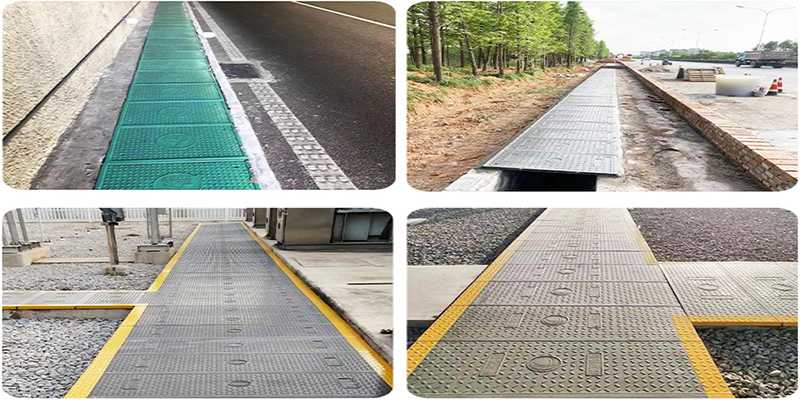
Fiberglass cable trench covers are used in industrial, utility, electrical, and infrastructure environments where non-metallic trench protection and project-specific load and environmental considerations are relevant.
- Power generation stations and electrical substations
- Manufacturing plants and industrial facilities
- Telecommunication and fiber-optic network routes
- Municipal and public utility systems
- Railway, metro, and transportation infrastructure
- Chemical and petroleum processing sites
- Underground cable routes serving commercial buildings
- Utility channels, drainage channels, and conduit protection areas
Application selection depends on the required load, trench opening, support arrangement, environmental exposure, and installation conditions.
Load Capacity
Load requirements for a fiberglass cable trench cover depend on the specified cover configuration and supporting conditions. Important design variables include:
- Cover thickness and reinforcement arrangement
- Span between supports and support frame geometry
- Resin system and expected temperature conditions
- Expected traffic type and loading conditions
- Trench opening dimensions and installation arrangement
Load and deflection requirements are evaluated for the specified configuration. Changes in span, thickness, reinforcement, support conditions, or loading conditions may require a different configuration.
Selection Considerations
When selecting a fiberglass cable trench cover, consider the following project variables:
- Load requirements: Define the expected pedestrian, vehicle, equipment, or other surface loading conditions.
- Span and support conditions: Trench opening dimensions and support frame geometry affect the required cover configuration.
- Resin system: Resin selection depends on the expected chemical and environmental exposure.
- Surface texture: Smooth and anti-slip surface options can be considered according to the installation environment.
- Outdoor exposure: UV-related requirements should be considered for installations exposed to outdoor conditions.
- Installation method: The cover configuration should match the support frame and installation arrangement.
- Field modification: Any cutting or drilling should be followed by appropriate edge sealing of the modified area.
Technical Specifications
Fiberglass cable trench covers can be configured according to project requirements. Available characteristics may include:
- Material: FRP/GRP composite with glass fiber reinforcement and thermosetting resin
- Surface texture: Smooth or anti-slip
- Dimensions: Project-specified according to trench opening and support conditions
- Reinforcement: Configuration dependent on load and span requirements
- Resin system: Selection depends on environmental and chemical exposure requirements
- Color: Available color options depend on the selected product configuration
- Temperature: Applicable service conditions depend on the selected resin system and project requirements
- UV protection: UV-related surface or resin options may be considered for outdoor exposure
- Fire performance: Fire-related resin or configuration requirements can be considered where specified by the project
- Installation: Configuration depends on the trench support and installation arrangement
Frequently Asked Questions
Can a fiberglass cable trench cover be used for vehicle areas?
Fiberglass cable trench covers can be configured for different loading conditions, including areas exposed to vehicle traffic. The required configuration depends on the cover dimensions, thickness, reinforcement, span, support conditions, and expected loading.
How is the service life of a fiberglass cable trench cover determined?
Service conditions such as loading, chemical exposure, UV exposure, temperature, installation arrangement, and maintenance conditions should be considered when evaluating the expected service performance of a trench cover.
Is fiberglass suitable for corrosive environments?
FRP can be specified for environments where corrosion resistance is a design consideration. The appropriate resin system depends on the chemicals, concentration, temperature, exposure pattern, and other project conditions.
Are custom sizes available?
Cover dimensions and configuration can be considered according to the trench opening, support conditions, and required loading. Project-specific requirements should be provided to determine the appropriate configuration.
Is FRP suitable for electrical installations?
FRP is a non-metallic, electrically insulating material and can therefore be considered for electrical and utility infrastructure where these material characteristics are relevant to the application.
Related Products & System Components
Fiberglass cable trench covers can form part of a broader cable route or trench protection arrangement. Related components may include:
- FRP cable trays and cable support structures
- Access covers and support frames for inspection areas
- Fastening and anchoring components for installation
Related product selection depends on the trench arrangement, support structure, installation conditions, and overall cable management requirements.
Engineering Inquiry
For project-specific configuration requirements, provide the main trench and operating conditions so the appropriate cover arrangement can be evaluated.
- Trench opening dimensions and support details
- Expected traffic type and loading conditions
- Chemical exposure and ambient temperature conditions
- Indoor or outdoor installation conditions
- Surface finish preference: smooth or anti-slip
- Any project-specific environmental or fire-performance requirements


