

Stainless Steel FRP Grating Clips Overview
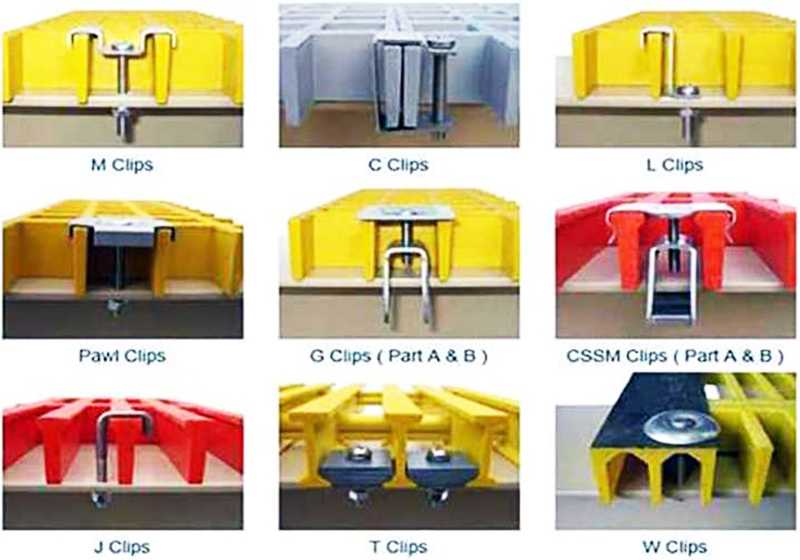
Stainless steel FRP grating clips are mechanical fastening components used with FRP or GRP grating systems. Also known as FRP grating fasteners, hold-down clips, or grating clamps, they are available in configurations such as M-clips, C-clips, and L-clips. These clips are used to secure or connect grating panels within a support assembly, with the installation function depending on the clip configuration. Stainless steel grades such as SS304 and SS316 allow selection according to the installation environment and support requirements.
What Are Stainless Steel FRP Grating Clips?
Stainless steel FRP grating clips are mechanical fasteners for installing molded or pultruded FRP grating. They use a clamp-based fastening approach rather than drilling or welding through the grating panel. Clip configuration and fastening arrangement are selected according to the grating type, panel thickness, and support structure.
Key Product Facts
- Material: Stainless steel, including SS304 and SS316 grades.
- Clip types: M-clips, C-clips, and L-clips.
- Compatibility: Molded and pultruded FRP grating.
- Function: Mechanical fastening for grating installation or panel connection, depending on clip configuration.
- Installation: Clamp-based mechanical fastening without drilling or welding through the grating panel.
Material & Construction
The clips are made from stainless steel for applications where resistance to moisture and corrosive exposure is required. SS304 and SS316 are common stainless steel grades used for fastening components, with grade selection based on the installation environment.
- SS304: Commonly selected for general industrial and outdoor environments with moderate corrosion exposure.
- SS316: Provides higher resistance to chloride-related corrosion than SS304 and is commonly selected for marine, coastal, and other chloride-exposed environments.
Clip geometry varies by configuration to suit different grating and support arrangements. The fastening assembly may include the clip body and associated hardware required for installation.
FRP Grating Clip Types
Different clip configurations are used for different FRP grating installation arrangements:
- M-clips: Clamp-style fasteners used in grating support applications.
- C-clips: Clip-style connectors used according to the grating connection arrangement.
- L-clips: Angle-type fastening clips used for securing grating within the support assembly.
The appropriate clip configuration depends on the grating type, panel thickness, support geometry, and required fastening arrangement.
Applications
Stainless steel FRP grating clips are used wherever molded or pultruded FRP grating is installed. Common application areas include:
- Chemical processing facilities
- Oil and gas facilities
- Wastewater treatment plants
- Power generation facilities
- Marine and offshore installations
- Industrial walkways and platforms
- Stair treads and access areas
Selection Considerations
Selection of stainless steel FRP grating clips generally considers:
- Grating type, whether molded or pultruded
- Grating panel thickness
- Support structure material and geometry
- Environmental exposure, including moisture, chemicals, and chlorides
- Stainless steel grade, such as SS304 or SS316
- Fastening arrangement and installation access
- Number and location of clips required for the grating installation
Clip selection should match the actual grating and support configuration used in the project.
Technical Specifications
| Characteristic | Description |
|---|---|
| Material | Stainless steel, including SS304 and SS316 |
| Clip types | M-clips, C-clips, and L-clips |
| Compatible grating | Molded and pultruded FRP grating |
| Fastening method | Mechanical clamp-based fastening |
| Installation use | Grating support restraint or panel connection, depending on clip configuration |
| Environment | Indoor, outdoor, industrial, coastal, or marine applications subject to grade selection |
Frequently Asked Questions
Are stainless steel FRP grating clips suitable for outdoor use?
Yes, stainless steel clips can be used for outdoor FRP grating installations. SS304 is commonly used for general outdoor environments, while SS316 is commonly selected where greater chloride exposure or marine conditions are present.
Do the clips require drilling through the FRP grating?
The clip-based fastening method is designed to secure the grating without drilling or welding through the grating panel. The exact installation arrangement depends on the clip type and support configuration.
What is the difference between SS304 and SS316 clips?
Both are stainless steel grades used for fastening components. SS316 provides higher resistance to chloride-related corrosion than SS304, making it a common choice for marine, coastal, and other chloride-exposed environments.
Which clip type should be used for FRP grating?
The appropriate clip depends on the grating type, panel thickness, support structure, and connection arrangement. M-clips, C-clips, and L-clips serve different installation configurations.
Engineering Inquiry
For project-specific clip selection, provide the following information so the fastening arrangement can be matched more closely to the installation:
- Grating type and panel thickness
- Support structure material and geometry
- Environmental exposure, including chemicals, moisture, or chlorides
- Preferred stainless steel grade, if specified
- Approximate quantity and installation scope


