FRP Rebar Overview FRP rebar—also called GFRP rebar or fiberglass rebar—is a non-metallic reinforcement bar made from continuous glass fibers embedded in a thermosetting resin matrix. It is used for... Read More
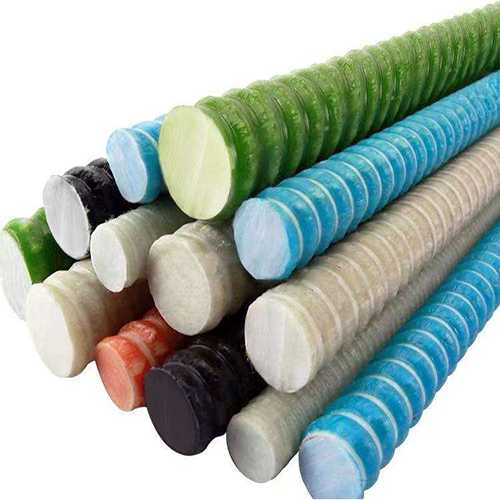
FRP rebar—also called GFRP rebar or fiberglass rebar—is a non-metallic reinforcement bar made from continuous glass fibers embedded in a thermosetting resin matrix. It is used for concrete reinforcement where corrosion resistance, low electrical conductivity, or non-metallic reinforcement is required. FRP rebar is typically produced by pultrusion, with a ribbed or sand-coated surface used to develop bond with concrete. Product characteristics vary with bar size, fiber content, resin system, and surface treatment.
What Is FRP Rebar?
FRP rebar is a glass fiber reinforced polymer bar designed for use as reinforcement in concrete. The bar combines continuous glass fibers with a polymer resin matrix, with the fibers primarily aligned along the bar length. This structure gives FRP rebar its characteristic tensile behavior and non-metallic material properties.
Key Product Facts
Material: Continuous glass fibers embedded in a thermosetting resin matrix.
Manufacturing process: Pultrusion, which aligns the reinforcing fibers along the length of the bar.
Surface: Ribbed or sand-coated configurations are used to develop bond with concrete.
Primary use: Non-metallic reinforcement for concrete structures.
Material characteristics: Non-metallic, lightweight relative to steel reinforcement, and suitable for applications where corrosion or electrical properties are important design considerations.
Material & Construction
FRP rebar is manufactured by pultrusion. Continuous glass fiber rovings are combined with a resin matrix and formed through a heated die, where the composite takes its final cross-sectional shape and the resin cures. The longitudinal fiber arrangement provides the primary reinforcement along the bar axis.
The resin matrix surrounds the glass fibers and forms the polymer phase of the composite. The bar surface may be formed with ribs or provided with a sand-coated finish to support mechanical interaction with concrete. Fiber content, resin system, bar geometry, and surface treatment are selected according to the intended product configuration and application requirements.
Applications
FRP rebar is used in concrete structures where non-metallic reinforcement is preferred or where exposure conditions make corrosion-related considerations important. Common application areas include:
Marine and coastal structures such as seawalls, piers, and bridge decks
Water and wastewater treatment facilities
Chemical processing plants and containment structures
Power generation facilities and substations
Transportation infrastructure exposed to de-icing salts
Underground structures and tunnel linings
Selection Considerations
Selection of FRP rebar typically involves several product and project variables:
Bar diameter and required tensile properties for the structural design
Resin system in relation to the expected exposure environment
Fiber content and modulus characteristics in relation to stiffness requirements
Surface treatment and bar geometry for concrete bonding
Thermal expansion characteristics in relation to the surrounding concrete
Concrete cover, development requirements, and installation conditions
Long-term loading conditions such as sustained and cyclic loads
Product selection is based on the required bar properties, structural conditions, exposure environment, and the selected product configuration.
Technical Specifications
The following table summarizes general characteristics of FRP rebar. Product properties vary according to bar size, fiber content, resin system, surface treatment, and overall configuration.
General characteristics of FRP rebar
Characteristic
Description
Material type
Glass fiber reinforced polymer (GFRP)
Manufacturing process
Pultrusion
Reinforcement
Continuous glass fibers
Matrix
Thermosetting polymer resin
Surface treatment
Ribbed or sand-coated configurations for concrete bonding
Bar diameter
Selected according to product configuration and structural requirements
Tensile properties
Determined by the fiber content, resin system, bar size, and product configuration
Modulus of elasticity
Determined by the composite material system and fiber content
Electrical characteristics
Non-metallic and suitable for applications where low electrical conductivity is required
Frequently Asked Questions
Can FRP rebar be used instead of steel reinforcement?
FRP rebar is used as a non-metallic reinforcement option in concrete structures. Its tensile behavior, stiffness, and bond characteristics differ from those of steel, so FRP rebar is selected as part of the structural design rather than treated as a direct material-for-material substitution.
Does FRP rebar bond with concrete?
Yes. Ribbed and sand-coated surfaces are used to develop interaction between the bar and surrounding concrete. Bond behavior depends on the surface treatment, bar geometry, concrete properties, and installation conditions.
Is FRP rebar suitable for electrical or magnetic environments?
FRP rebar is non-metallic and does not have the electrical and magnetic characteristics of steel reinforcement. It can therefore be considered for applications where low electrical conductivity or non-magnetic reinforcement is an important design consideration.
Can FRP rebar be cut on site?
FRP rebar can be cut with suitable abrasive or diamond cutting tools. Cutting can generate composite dust, so appropriate dust control and personal protective equipment should be used during fabrication and installation.
Does FRP rebar rust?
FRP rebar is non-metallic and does not rust in the same way as steel reinforcement. Its long-term behavior depends on the composite material system and the conditions to which the reinforcement is exposed.
Engineering Inquiry
For product selection or project evaluation, share the main requirements that affect reinforcement selection:
Required bar diameter and length
Structural tensile and stiffness requirements
Concrete cover and reinforcement arrangement
Expected exposure conditions, including chemical, moisture, and temperature conditions
Approximate quantity and required delivery schedule